99
99 info@finarraywealth.com




Large Investment Opportunities Often Require More Than One Investor
Many high-value investment opportunities are inaccessible to individual investors because of high capital requirements, complex due diligence, and limited deal availability.
This is where Fund Syndication becomes valuable.
Instead of a single investor deploying a significant amount of capital, multiple High Net Worth Individuals (HNIs), Ultra HNIs, Family Offices, and Institutional Investors come together to participate in carefully evaluated investment opportunities.
At FinArray Wealth, we help qualified investors understand, evaluate, and participate in suitable syndication opportunities through a structured advisory approach backed by financial analysis, risk assessment, and professional guidance.
Whether you are an investor looking for portfolio diversification or a business seeking strategic capital, fund syndication creates a bridge between capital and opportunity.
What is Fund Syndication?

Fund Syndication is a structured investment arrangement where multiple investors collectively participate in a single investment opportunity.
Instead of one investor contributing the entire investment amount, the required capital is raised from several qualified investors.
These opportunities may include:
- Private Equity
- Growth Capital
- Pre-IPO Opportunities
- Commercial Real Estate
- Infrastructure Projects
- Venture Capital Investments
- Alternative Investment Opportunities
- Structured Debt Opportunities
- Business Expansion Funding
Each investor contributes capital according to predefined terms while maintaining transparency regarding investment structure, timelines, governance, and expected outcomes.
Why Fund Syndication is Becoming Popular in India
India’s wealth landscape has evolved significantly over the past decade.
Today, many HNIs and family offices are looking beyond traditional investments like:
- Fixed Deposits
- Mutual Funds
- Listed Equity
- Gold
- Residential Real Estate
They seek opportunities that offer:
- Portfolio diversification
- Access to exclusive investment opportunities
- Better long-term wealth creation potential
- Exposure to private markets
- Professional deal evaluation
Fund syndication enables investors to participate in opportunities that may otherwise require substantial minimum investments.
Who Can Benefit from Fund Syndication?
Fund syndication is generally suitable for investors with larger investment capacities and a long-term perspective.
It may be appropriate for:
High Net Worth Individuals (HNIs)
Individuals seeking access to private investment opportunities beyond traditional markets.
Ultra High Net Worth Individuals (UHNIs)
Investors looking to diversify across multiple asset classes and alternative investments.
Family Offices
Families managing multi-generational wealth often use syndication to diversify portfolios while maintaining disciplined capital allocation.
Business Owners
Entrepreneurs with surplus funds may allocate a portion of their wealth toward professionally evaluated investment opportunities.
Professionals
Doctors, Chartered Accountants, Corporate Executives, and Entrepreneurs seeking strategic portfolio diversification.
How Fund Syndication Works
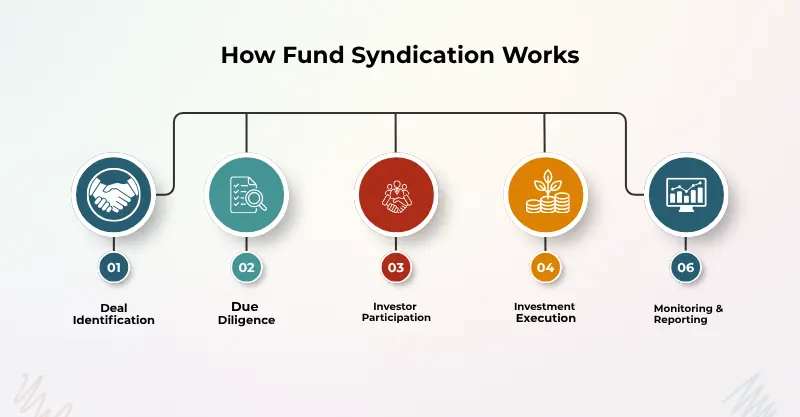
Step 1: Deal Identification
Suitable investment opportunities are identified based on:
- Business fundamentals
- Market potential
- Financial performance
- Management quality
- Exit possibilities
Step 2: Due Diligence
Professional evaluation includes:
- Financial Analysis
- Legal Verification
- Regulatory Compliance
- Industry Research
- Business Risk Assessment
- Valuation Review
- Management Evaluation
This stage helps investors understand both potential returns and associated risks.
Step 3: Investor Participation
Interested investors review:
- Investment Memorandum
- Capital Requirement
- Investment Structure
- Lock-in Period
- Exit Strategy
- Risk Factors
Investors participate only after completing required documentation and compliance procedures.
Step 4: Investment Execution
Capital is deployed according to the agreed structure while ensuring regulatory and documentation compliance.
Step 5: Monitoring & Reporting
Depending on the investment structure, investors may receive periodic updates covering:
- Business performance
- Financial developments
- Portfolio updates
- Key milestones
- Exit developments
Key Benefits of Fund Syndication
Access to Exclusive Opportunities
Many private investment opportunities are not publicly available.
Syndication allows investors to participate in opportunities generally accessible only to institutional investors or large family offices.
Portfolio Diversification
Rather than concentrating wealth in one asset class, investors can diversify across:
- Private Equity
- Real Estate
- Alternative Investments
- Growth Businesses
- Structured Investments
Diversification helps manage overall portfolio risk.
Professional Due Diligence
One of the biggest advantages is access to structured evaluation before investing.
Professional due diligence reduces information gaps and supports informed investment decisions.
Efficient Capital Allocation
Instead of investing a large amount in one opportunity, investors can spread investments across multiple opportunities over time.
Strategic Co-Investing
Investors participate alongside other sophisticated investors who often bring valuable business experience and strategic insights.
Common Types of Fund Syndication Opportunities
Private Equity Investments
Capital invested into growing private businesses with long-term growth potential.
Commercial Real Estate
Investment opportunities in:
- Office Spaces
- Warehouses
- Industrial Parks
- Commercial Developments
- Mixed-use Projects
Pre-IPO Investments
Participation in eligible companies before they become publicly listed, subject to applicable regulations and investment terms.
Infrastructure Projects
Investment opportunities related to logistics, renewable energy, transportation, and infrastructure development.
Alternative Investment Opportunities
Selected investment structures designed for qualified investors seeking exposure beyond traditional financial markets.
Risks Investors Should Understand
Every investment carries risk.
Fund syndication is no exception.
Potential risks include:
Liquidity Risk
Some investments may have longer holding periods.
Market Risk
Economic conditions can affect business performance.
Business Risk
Company-specific challenges may impact returns.
Regulatory Risk
Changes in laws or regulations may influence investment outcomes.
Valuation Risk
Investment values may fluctuate depending on business performance and market conditions.
Proper due diligence and diversification remain essential.
How FinArray Helps Investors Evaluate Opportunities

At FinArray Wealth, our approach focuses on informed decision-making rather than product distribution.
Our advisory process includes:
Investment Opportunity Screening
Evaluating opportunities against defined investment criteria.
Financial Analysis
Reviewing financial statements, business models, and projected performance.
Risk Assessment
Identifying key financial, operational, legal, and market risks.
Read More: Mitigating Investment Risks: The Critical Role of Timely Updates in Financial Records
Documentation Support
Assisting with investment documentation and compliance requirements.
Portfolio Alignment
Helping investors assess whether an opportunity aligns with their broader financial objectives and asset allocation.
Why HNIs Prefer Professional Advisory Before Investing
Experienced investors understand that investment success depends on more than identifying attractive opportunities.
Professional advisory provides:
- Independent analysis
- Better risk understanding
- Portfolio diversification guidance
- Documentation assistance
- Ongoing monitoring
- Structured investment evaluation
This disciplined approach supports informed decision-making while helping investors avoid emotionally driven investment choices.
Why Choose FinArray Wealth for Fund Syndication Advisory?
Our focus extends beyond introducing investment opportunities.
We work to ensure investors have clarity regarding:
- Investment suitability
- Risk considerations
- Portfolio allocation
- Financial implications
- Documentation processes
- Long-term wealth planning
With our client-first advisory philosophy, we aim to support investors through every stage of the investment journey.
Conclusion
As investment opportunities continue to evolve, fund syndication offers qualified investors a structured way to access larger, professionally evaluated opportunities that may not be available through traditional investment channels. By combining capital with thorough due diligence and disciplined portfolio planning, HNIs and family offices can broaden their investment universe while managing risk thoughtfully.
FinArray Wealth supports investors through a research-driven advisory approach, helping evaluate opportunities, understand risks, and align investments with long-term financial objectives.
Connect with our experts today to discuss whether fund syndication is the right fit for your investment strategy.
Frequently Asked Questions (FAQs)
What is fund syndication?
Fund syndication is a process where multiple investors jointly invest in a single investment opportunity, allowing participation in larger deals through shared capital.
Who should consider fund syndication?
It is generally suitable for HNIs, UHNIs, family offices, entrepreneurs, and eligible investors seeking diversification into private market opportunities, subject to applicable regulations and suitability assessments.
Is fund syndication risky?
Yes. Like all investments, fund syndication involves risks, including market, liquidity, business, valuation, and regulatory risks. Investors should assess suitability and conduct thorough due diligence before investing.
What types of opportunities are available through fund syndication?
Opportunities may include private equity, commercial real estate, infrastructure, structured investments, growth capital, and other alternative investments, depending on availability and investor eligibility.
How is fund syndication different from mutual funds?
Mutual funds pool money into diversified portfolios managed according to the scheme’s investment objective. Fund syndication typically involves investors collectively participating in specific private investment opportunities and may have different risk, liquidity, and regulatory characteristics.
Read More: Mutual Funds Unlocked: Grow Smarter, Invest Better
Can family offices participate in fund syndication?
Yes. Family offices often use fund syndication as part of their broader wealth management and diversification strategy, subject to their investment policy and applicable regulations.
Disclaimer: The information provided in this article is intended solely for educational and informational purposes and should not be construed as investment, legal, tax, or financial advice, nor as an offer, invitation, or solicitation to buy or sell any securities or investment products. Investment opportunities discussed may be available only to eligible investors and are subject to applicable laws, regulatory requirements, and suitability assessments. All investments involve risks, including the possible loss of principal. Past performance is not indicative of future results. Investors are advised to conduct their own due diligence and consult qualified financial, legal, and tax professionals before making any investment decisions.