99
99 info@finarraywealth.com




Introduction
You earn ₹50,000 a month. Your family depends on it for rent, EMIs, school fees, and daily expenses. Now imagine that income disappearing overnight.
No one likes thinking about it, but it is a reality that cannot be ignored. Even in 2026, a large percentage of Indians remain underinsured. Most either have no life cover or rely on traditional policies that offer very low coverage compared to their actual needs.
This creates a dangerous gap between responsibility and protection.
Term insurance solves this problem simply and cost-effectively. By the end of this post, you will understand what term insurance is, how it works, and how to choose the right plan in 2026.
What Is Term Insurance and Why Do Most People Get It Wrong
Term insurance is the simplest form of life insurance. You pay a fixed premium every year, and if an unfortunate event occurs during the policy term, your family receives a large lump sum amount known as the sum assured. If you survive the policy term, the plan ends.
Many people confuse term insurance with investment-based products like ULIPs or endowment plans. These products combine insurance and returns, which leads to higher premiums and lower coverage.
For example, in 2026, a healthy 28-year-old can get a ₹1 crore term plan for approximately ₹15,000 to ₹20,000 per year, depending on the insurer and profile. The same coverage in a traditional plan may cost significantly more.
This is why financial experts recommend a simple approach. Use term insurance for protection and invest separately for wealth creation.
Term Insurance Age Limit
Here is a simple point-wise explanation you can add to your blog:
- The entry age for term insurance typically starts from 18 years
- Maximum entry age usually ranges between 60 and 65 years, depending on the insurer
- Some plans offer whole life coverage up to 75 or even 85 years, till 99
- The earlier you buy, the lower your premium remains for the entire policy term
- Buying at a younger age also increases the chances of approval with fewer medical conditions
- The ideal buying age for most individuals is between 25 to 35 years
- Policy term should ideally cover your working years or until major financial responsibilities are completed
- Delaying purchase can lead to higher premiums and possible exclusions due to health issues
- Different insurers may have slightly different age limits and policy terms
- Always choose a tenure that aligns with your long-term financial goals and family responsibilities
This makes it easy for readers to quickly understand and take action.
Term Insurance Benefits: What You Actually Get
A well-chosen term insurance plan provides multiple advantages.
It offers high coverage at an affordable premium. A ₹1 crore cover for a healthy individual can cost around ₹1250 to ₹1,800 per month in 2026.
It provides tax benefits. Premiums qualify for deduction under Section 80C, and the claim amount received by nominees is tax-free under Section 10(10D), subject to prevailing tax laws.
It allows you to add riders such as critical illness cover, accidental death benefit, and waiver of premium, enhancing your overall protection.
There is also an option for return-of-premium plans. In such plans, the premiums paid are returned at maturity, but the cost is significantly higher compared to standard term plans.
Term insurance plans also offer flexible tenure options, often covering individuals up to the age of 65 or 75. Buying early helps lock in lower premiums for the long term.
Term Insurance vs Life Insurance: Which One Should You Pick
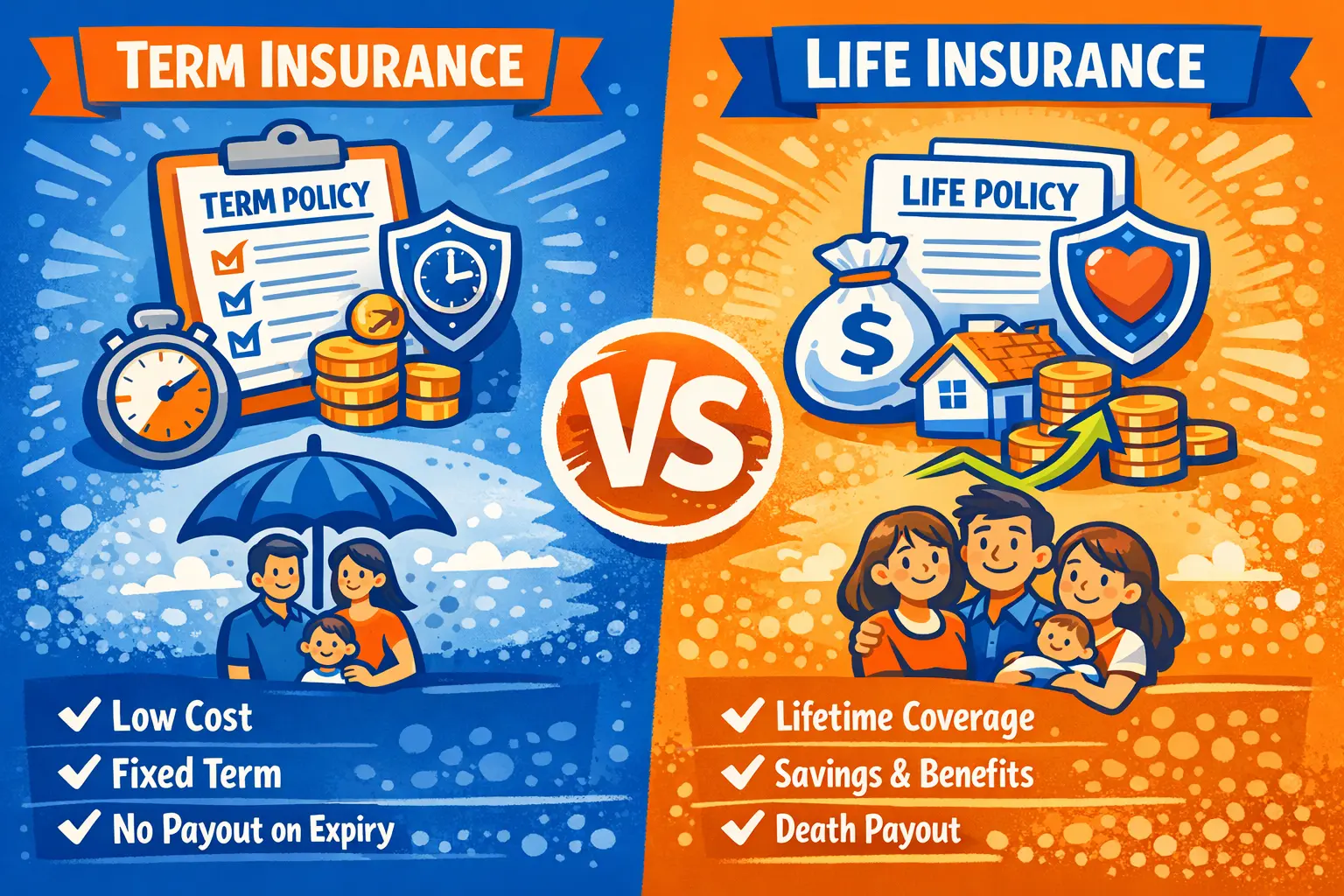
Term insurance focuses purely on financial protection, while traditional life insurance plans combine protection with savings.
Term plans provide higher coverage at a lower cost and are ideal for salaried individuals and families with financial responsibilities. Traditional plans offer maturity benefits but generally provide lower returns and limited coverage.
If your goal is to protect your family’s financial future, term insurance is the more efficient choice. Investments like mutual funds and SIPs should be used separately to build wealth.
Real Example: Rahul, 30, Software Engineer
Rahul earns ₹80,000 per month in 2026. He has a home loan of ₹40 lakh, a dependent spouse, and a young child.
He purchased a ₹1 crore term insurance plan for approximately ₹15000 per year. This means he secured his family’s future for nearly ₹1250 per month.
In case of an unfortunate situation, his family would have enough financial support to clear liabilities and maintain stability.
This reflects practical and responsible financial planning.
Term Insurance Benefits After Maturity
One of the most common questions people ask is what happens if you outlive your term insurance policy.
In a standard term insurance plan, there is no maturity benefit. If the policyholder survives the policy term, the plan simply ends, and no payout is made. This is because term insurance is designed purely for risk protection and not for savings or investment.
However, this does not mean you receive no value. Throughout the policy period, you have secured your family’s financial future at a very low cost. That protection itself is the core benefit of a term plan.
For those who prefer getting something back at the end of the policy term, there is an option called Term Insurance with Return of Premium. In this type of plan, all the premiums paid during the policy term are returned if the policyholder survives. The trade-off is that the premium for such plans is significantly higher compared to a standard term plan.
It is important to understand that term insurance should not be evaluated based on maturity returns. Its primary purpose is to provide financial security to your family in case of an unfortunate event.
If your goal is wealth creation or returns, it is better to invest separately through instruments like mutual funds or other investment options while keeping term insurance strictly for protection.
Key Takeaways
- Term insurance provides high coverage at an affordable cost
- Buying early helps lock in lower premiums for the long term
- Insurance and investment should be kept separate
- Return of premium plans are available, but cost significantly more
- Tax benefits are available as per current regulations
How FinArray Helps You with Term Insurance
Choosing the right term insurance plan can feel confusing, but FinArray makes the process simple, transparent, and personalised.
- We help you calculate the right coverage based on your income, expenses, and financial responsibilities
- We compare plans from trusted insurers like Bajaj Life, HDFC Life Insurance, ICICI Prudential Life Insurance, and Max Life Insurance to find the best fit
- We guide you in selecting the right policy term and suitable riders based on your needs
- We simplify complex policy terms and conditions so you can make informed decisions
- We ensure complete transparency with no hidden agenda or product pushing
- We assist you through the entire process, from plan selection to application and documentation
- We provide ongoing support, including policy review and updates, as your life goals change
At FinArray, our goal is not just to sell a policy but to help you build a strong financial safety net for your family.
Do not delay your financial protection. Secure your family’s future with the right term insurance plan.
Connect with FinArray Mini Office today for a personalised consultation. Compare plans, understand your coverage needs, and make an informed decision with confidence.
Disclaimer
This content is for educational and informational purposes only and should not be considered as financial advice. Insurance products are subject to the terms and conditions of the respective insurer. Premiums, benefits, and coverage may vary based on individual profiles, underwriting guidelines, and policy terms. Tax benefits are subject to changes in applicable laws. Readers are advised to consult a qualified financial advisor before making any insurance or investment decisions.
FAQ
Q1. What is the right age to buy term insurance?
The ideal age is between 25 and 35. Premiums are lowest, health conditions are typically clean, and you lock in a low rate for the entire policy duration.
Q2. How much cover do I actually need?
A common rule of thumb is 10–15 times your annual income. If you earn ₹8 lakh per year, a ₹1–1.2 crore cover is a good starting point. Add your outstanding loans on top of that.
Q3. Term insurance benefits after maturity, do I get anything?
In a standard term plan, no. If you outlive the policy, it simply ends. If you want a payout at maturity, opt for TROP, but be prepared to pay 2–3x the premium.
Q4. What is the difference between term insurance and life insurance?
Term insurance is a type of life insurance, the simplest and most affordable one. “Life insurance” is a broader category that also includes ULIPs, endowment plans, and money-back policies. For pure family protection, term insurance is the recommended choice.