99
99 info@finarraywealth.com




Rajan did everything right.
He researched Specialized Investment Funds (SIFs).
He understood the concept.
He liked what regulators had built.
And then he opened his investment app and had no idea where to start.
If that sounds familiar, you are not alone. Let us simplify it.
What Are Specialized Investment Funds (SIFs)?
India’s investment ecosystem has evolved significantly from mutual funds to Portfolio Management Services (PMS) and Alternative Investment Funds (AIFs). However, there has always been a gap.
Mutual funds are highly regulated but offer limited flexibility.
PMS and AIFs provide greater flexibility but require high investment amounts.
Specialized Investment Funds (SIFs) sit between these two.
They combine the structure of mutual funds with selected flexibility seen in PMS and AIFs.
SIFs are regulated by SEBI, designed for relatively sophisticated investors, and built to enable more strategic portfolio management.
Where Do SIFs Fit?
| Product | Minimum Investment | Flexibility | Risk | Liquidity |
| Mutual Funds | ₹500 – ₹5,000 | Low | Moderate–High | High |
| SIFs | ₹10 Lakhs | Medium–High | High | Moderate |
| PMS | ₹50 Lakhs | High | High | Limited |
| AIFs | ₹1 Crore | Very High | High | Limited |
Key Takeaway
SIFs are not entry-level investments. They are portfolio enhancers, not the foundation.
What Makes SIFs Different?
Unlike traditional mutual funds, SIFs offer greater flexibility in investment strategies.
They allow active use of derivatives, the ability to take both long and short positions, and dynamic allocation across multiple asset classes such as equity, debt, commodities, and REITs.
In simple terms, going long means buying when the outlook is positive, while going short means benefiting from falling prices. Dynamic allocation allows fund managers to shift between asset classes based on market conditions.
SIFs can also take limited short exposure in unhedged derivative positions, making them more tactical in nature.
Why Were SIFs Introduced?
Traditional mutual funds operate under strict rules, including limits on derivatives usage, diversification norms, and concentration exposure.
SIFs were introduced to provide fund managers with greater flexibility, enable advanced investment strategies, improve risk management, and allow more sophisticated portfolio construction.
While taxation is similar to mutual funds, SIFs may have restricted liquidity, such as limited redemption windows or fixed maturity structures.
Who Should Consider SIFs?
Before investing in SIFs, investors should evaluate their readiness.
You may consider SIFs if you can invest ₹10 lakhs in a single strategy, have a minimum investment horizon of three years, and already have an emergency fund, term insurance, health insurance, and a core mutual fund portfolio in place.
If these conditions are not met, SIFs should not be your starting point.
Types of SIF Strategies:
Equity-Oriented Strategies
These include equity long-short funds and sector rotation strategies. They focus on equity markets with tactical opportunities to take short positions.
Debt-Oriented Strategies
These include debt long-short funds and sector-specific debt strategies. They focus on fixed income with added flexibility.
Hybrid Strategies
These include active asset allocation and multi-asset long-short funds. They invest across equity, debt, commodities, and REITs to achieve diversification.
How to Invest in SIFs
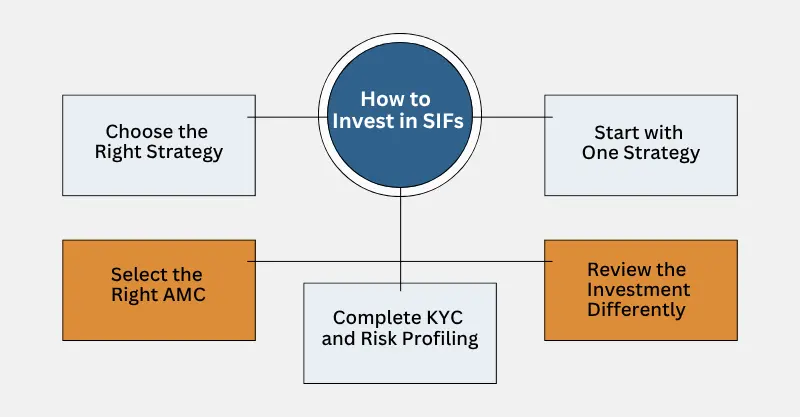
Step 1: Choose the Right Strategy
The choice should depend on your portfolio gap rather than current market trends.
Step 2: Select the Right AMC
Focus on the experience of the fund manager, clarity of strategy, and risk management framework. This is not a product that should be chosen based on ratings alone.
Step 3: Complete KYC and Risk Profiling
Accurate risk profiling is essential. Investors should be honest about their risk tolerance.
Step 4: Start with One Strategy
Each SIF is a concentrated investment. It is advisable to begin with a single strategy and scale gradually.
Step 5: Review the Investment Differently
SIFs should not be tracked based on short-term returns. Instead, investors should evaluate whether the strategy is performing as intended. Reviews should be done periodically, not emotionally.
SIF Investment Checklist
- Ensure that you have sufficient liquidity for a ₹10 lakh investment.
- Invest only if the strategy addresses a specific gap in your portfolio.
- Verify the credibility of the AMC and fund manager.
- Complete proper risk profiling.
- Start with one strategy.
- Review performance based on strategy execution rather than short-term returns.
FinArray Insight: Where SIFs Fit in Your Portfolio
SIFs should be considered as part of advanced portfolio construction, typically in the third or fourth layer of investing. The foundation of any portfolio should remain mutual funds and long-term disciplined investing. SIFs can then be used selectively to enhance diversification, improve risk-adjusted returns, and introduce tactical flexibility.
The Real Truth About SIFs
- SIFs are not meant for chasing trends.
- They are designed to address specific portfolio needs, use advanced strategies responsibly, and align with long-term financial goals.
- Successful investing is not about choosing what is new, but about choosing what is appropriate for your financial situation.
Let’s Talk
If you are unsure whether SIFs are suitable for your portfolio, you can reach out to us. We aim to provide clarity without jargon or pressure.
If you still have questions around SIFs or portfolio fit, seeking clarity before investing can make a meaningful difference. Talk to our experts today and build a smarter, structured portfolio.
Disclaimer: Mutual fund investments are subject to market risks. Read all scheme-related documents carefully before investing. SIF investments involve higher risk and may not be suitable for all investors.